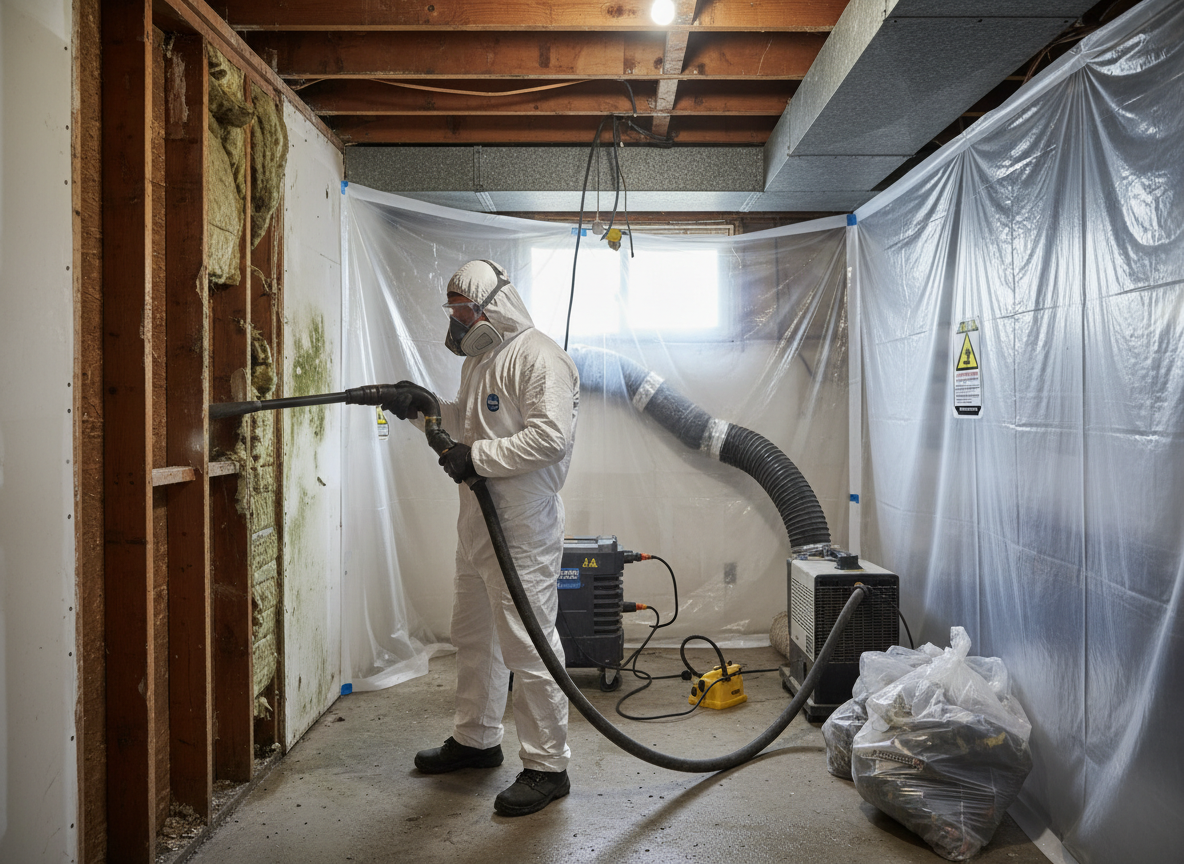
Edison sits in the San Joaquin Valley where hot arid summers dry surfaces quickly but mild winters and nearby irrigation canals keep soil and crawl spaces damp. Older single-story homes along Edison Highway often have unsealed pier-and-beam foundations that trap condensation from agricultural runoff. When homeowners notice musty odors after the first cool nights, the growth is usually hidden behind baseboards or under subfloors rather than on visible walls. Proper abatement requires negative-air containment and moisture mapping with meters because surface cleaning alone allows spores to reappear once temperatures rise again.
Removal work here focuses on porous materials common in Kern County construction such as gypsum board, particleboard cabinets, and carpet padding installed over concrete slabs. We cut out affected sections at least 18 inches beyond visible staining, bag debris on site, and HEPA-vacuum adjacent cavities. In homes near Bakersfield where roof leaks from rare winter storms have soaked attic insulation, we also remove and replace cellulose that has wicked water from the eaves. Drying follows with commercial air movers and dehumidifiers sized for the valley’s low humidity, which actually speeds the process once liquid water is extracted.
After abatement we document moisture levels below 12 percent and run clearance air sampling before any reconstruction. Homeowners in Edison frequently ask about returning furniture too soon; we advise waiting until readings stabilize because residual spores can reactivate if items are placed back on still-damp flooring. Coordination with local waste rules means all moldy material leaves the property the same day in sealed trucks rather than sitting curbside.
Technician insight
In EDISON, the thing that catches most people out with mold abatement is how irrigation water from nearby canals keeps the soil under older pier-and-beam houses damp year-round even when the San Joaquin Valley air feels bone-dry, so the mold you see in the living room is usually just the tip of growth that started weeks earlier in the crawl space.
Crawl Space Mold After Winter Runoff
A homeowner along Edison Highway noticed a musty smell after mild winter rains. Inspection showed black growth on joists fed by irrigation seepage under the house. We contained the crawl space, removed saturated insulation, dried the soil, and treated framing. Clearance testing passed within four days and the odor did not return.
How it works
- 1
Initial Assessment
We inspect Edison homes for visible and hidden mold using moisture meters and borescopes, focusing on crawl spaces and attics common in local housing.
- 2
Containment Setup
Plastic barriers and negative air machines isolate the work area to prevent spore spread through the dry valley air.
- 3
Material Removal
Affected drywall, insulation, and trim are cut out and bagged on site for immediate transport off the property.
- 4
Drying and Treatment
Commercial equipment dries remaining surfaces while antimicrobial agents are applied to framing and subfloors.
- 5
Clearance Verification
Post-remediation moisture checks and air sampling confirm levels before the space is released for rebuild.
Pricing
Cost depends on square footage affected, access to crawl spaces under Edison homes, and whether irrigation-related moisture requires extra drying time.